


Scenario 1
Your company is planning to adopt AI
We assess processes and infrastructure, identify suitable use cases, design the architecture and build a secure AI environment — from a pilot on real tasks to production operation.
Design enterprise AILEGEND-A · an ITBP JSC solution
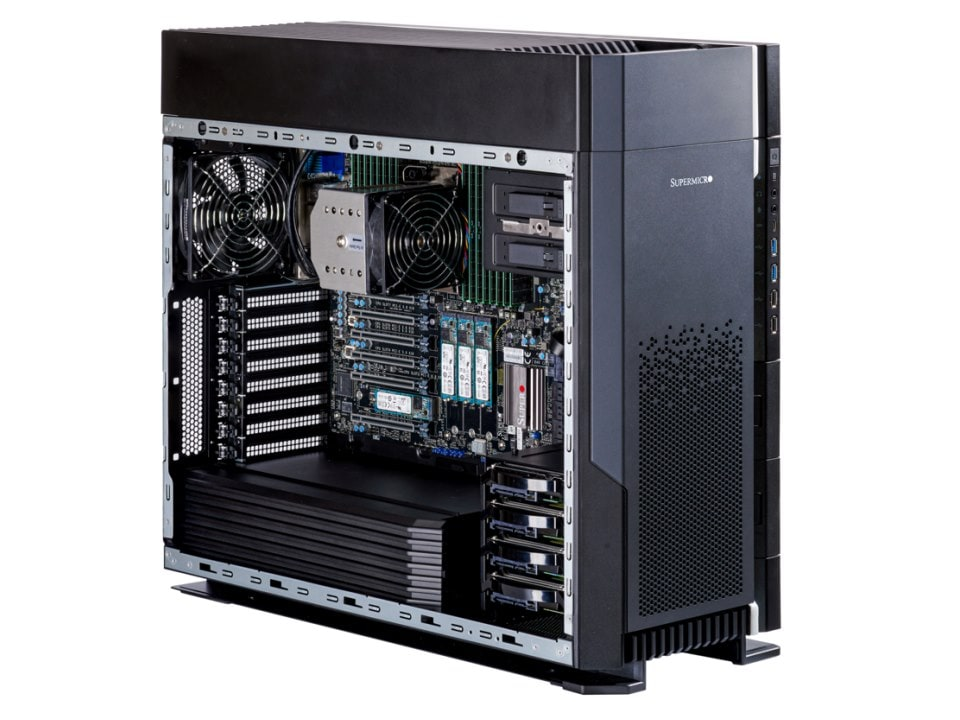
We supply AI servers and design and deploy enterprise AI systems. Workstations, GPU servers and infrastructure for local models, RAG, AI agents and machine learning workloads.
Your organisation retains control of data, access rights and AI actions.
01 · Infrastructure
Companies are adopting enterprise LLMs, RAG, AI agents and automation tools. At the same time, new access points emerge for documents, correspondence, databases, business systems, APIs and enterprise accounts.
Connecting models and agents to information systems creates a new interface to enterprise information. Enterprise AI should be treated as a complete information system, with an owner, boundaries, permissions, logs and security requirements.
Target architecture for an enterprise AI environment
Simplified diagram
Secure environment
Layer 1
Layer 2
This approach embeds AI in real business processes while retaining control over enterprise data, user permissions and agent actions. Enterprise AI security is designed alongside its functionality, rather than added after deployment.
02 · Solutions
ITBP JSC designs and deploys enterprise AI, assesses existing implementations and their architecture and security, establishes a secure AI environment, and provides control over data, permissions, agent actions and external connections.
Scenario 1
We assess processes and infrastructure, identify suitable use cases, design the architecture and build a secure AI environment — from a pilot on real tasks to production operation.
Design enterprise AIScenario 2
We inventory AI services and assess data flows, architecture, access and the security of existing AI systems. We then propose a target secure architecture and a risk mitigation plan.
Request an audit03 · Enterprise knowledge
Enterprise documents, correspondence, regulations, contracts, decision history and information from business systems form a managed knowledge base. The model answers using the organisation's sources and cites them.
Users and AI agents receive only the information they are authorised to access. Permissions are inherited from source systems and checked on every request.
Indexing
Connect sources, chunk and vectorise documents, and update indexes on a schedule or in response to events. Document versions and currency are tracked.
Access
Each answer uses only documents available to the specific user or agent. Source-system restrictions remain in force in the knowledge base.
Verifiability
Employees can see which documents and passages support an answer and open the original in its source system.
04 · AI agents in business processes
AI can both find information and participate in business processes through authorised tools: business systems, document management, email, APIs, RPA workflows and managed tool interfaces such as MCP.
Each agent operates within its assigned role, with the minimum necessary permissions and a complete action log.
Finance
Legal
Procurement
IT
Management
Information security
Critical actions can proceed only after confirmation by an authorised employee. Posting accounting documents, making payments, changing permissions, sending data outside the environment and other irreversible operations require explicit human confirmation.
05 · Secure environment
Enterprise documents and knowledge bases can be processed by local models without sending their content to an external AI provider. Deployment depends on the data, security requirements and the customer's computing resources.
Option A
LLMs, RAG and enterprise data run in the customer's infrastructure: a data centre, company servers or dedicated GPU nodes. Data stays within the organisation's perimeter.
Option B
Operation without public AI services and, where required, without Internet access. Models and components are updated through controlled customer procedures.
Option C
Sensitive data is processed locally, while authorised requests to external models pass through a controlled AI Gateway with policies, filtering and logging.
Models
We select models for the customer's tasks and hardware, including Russian and open models. A single access interface works regardless of where the model runs.
Infrastructure
GPU capacity, storage and network sizing for the workload. Deployment in existing virtualisation environments or on dedicated hardware.
Operations
Monitoring, redundancy, model and index updates, operating procedures and knowledge transfer to the customer's team.
06 · Enterprise AI security
Models, knowledge bases and agents access the same data as employees. They therefore require the same safeguards: access control, information-flow control, logging and monitoring.
01 · Access control
AI must not give an employee information they cannot access in the source system. Document, record and tool permissions are checked on every request.
02 · Data control
Control information transmitted by users, agents, APIs and external models. Integrate with DLP and information protection policies, including sensitive data classification and masking.
03 · Logging
Record requests, data access, AI agent actions, tool calls and operation results. Logs support audits and investigations.
04 · External LLM control
All external model requests pass through one gateway with policies, filtering and logging. Direct employee access to public AI services can be restricted.
05 · AI agent isolation
Each agent has only the permissions it needs. Potentially dangerous operations run in a sandbox, container or another isolated environment with network and file-system restrictions.
06 · Secret protection
API keys, tokens, passwords and other secrets are not included in prompts or context. Vaults, secret stores and a controlled tool gateway are used instead.
07 · Prompt injection
A dedicated protection layer against prompt injection, indirect prompt injection, instructions embedded in documents and web pages, and unauthorised tool calls.
08 · Monitoring
Monitor unusual behaviour, bulk information extraction, unexpected agent actions and requests to prohibited sources. Events are sent to the customer's SIEM and SOC.
07 · Standalone service
We review the AI services, local models, RAG and AI agents already used by your company. The audit is a standalone project with no requirement for subsequent deployment.
The result: a clear picture of which data goes where, who can access what through AI, which risks are critical and what to address first.
01
Identify the AI services, LLMs, agents, plugins and integrations actually used in the company, including unregistered ones.
02
What is sent to the model, where it is processed and stored, and who receives the result.
03
Which documents, systems, databases and APIs users and AI agents can access.
04
05
06
07
Identify requirements specific to the customer's infrastructure, based on the system category and the nature of its data.
08
To start, provide a list of the AI services in use and a diagram of your information systems. Audit scope and timing are agreed after a short introductory interview.
08 · Regulatory requirements
Enterprise AI deployments take account of requirements applicable to the customer's information system, facility category and the nature of the information processed. Enterprise AI is not a separate regulatory object in itself: its requirements are determined by the system it becomes part of.
Depending on the project, this may include requirements concerning:
ITBP JSC carries out licensed information protection activities, including the development and manufacture of confidential information protection tools. It supports customers in preparing information systems for conformity assessment and regulator inspections, including those by FSTEC of Russia.
Scope of AI environment protection work
The scope is agreed after assessment and depends on the class and category of the customer's information system.
09 · Project stages
The project follows an information-system deployment process: assessment, design documentation, a pilot using customer data, security analysis and handover to operations.
01
Business processes, systems, data, infrastructure and security requirements.
02
Identify processes where AI delivers measurable results.
03
LLMs, RAG, agents, integrations, computing infrastructure and security.
04
A limited environment built around the customer's real use cases.
05
Access, leakage, APIs, agents, logs and external services.
06
Integration into existing infrastructure.
07
Monitoring, auditing, support and use-case development.
10 · Pricing
Architecture, integration scope, computing infrastructure and security requirements are defined individually for each project. After assessment, the customer receives a preliminary architecture, scope of work and cost estimate.
About us
ITBP JSC is an integrated IT and security solutions provider. LEGEND-A is the company's enterprise AI business area; ITBP JSC delivers design, deployment, auditing, integration and support.
The company delivers full-cycle projects, from assessment and design to deployment, integration, protection and support for information and technical systems.
ITBP's information security expertise enables enterprise AI to be deployed within existing company infrastructure, accounting for access, data protection, information-flow control and AI operations requirements.
About ITBPITBP JSC capabilities
Licensed to develop and manufacture tools for protecting confidential information. Full company, licence and registration details are available on the ITBP JSC website.
88 Sredny Prospekt, Vasilyevsky Island, St Petersburg · +7 (812) 214-25-50 · info@it-s-p.ru
Starting a project
First, define the business processes, data, architecture and information security requirements.
ITBP JSC can help design, deploy or audit your company's existing AI environment.